
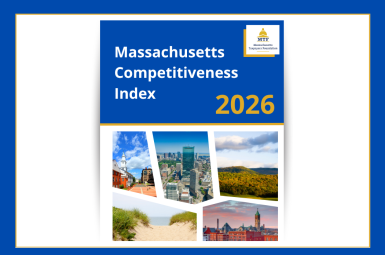
Each year, MTF publishes a Competitiveness Index and Companion Poll to provide a holistic look at how Massachusetts compares to competitor states and to gauge the opinion of residents on how Massachusetts is doing.
This is the third installment of the MTF Competitiveness Index, which is designed to provide residents, employers, and policymakers with a holistic assessment of how Massachusetts compares our regional and economic competitor states across 27 different metrics in four categories of competitiveness:
- Economic Health – fundamental elements of state economies;
- Population & Labor Force Trends – ongoing demographic, migration, and workforce patterns;
- Business, Employment & Investment Factors – how policy and investment decisions affect state business climates; and
- Resident Life – quality of life factors that impact residents every day.
In this edition, we use the 2025 Index as a baseline, and we present clear, comparable data to assess how decisions made in Massachusetts and factors outside of our control are shaping our competitiveness.
2026 Competitiveness Poll – MTF partnered with MassInc Polling Group on a companion poll that surveyed residents on their views of living in Massachusetts, as well as its competitive strengths and weaknesses. This year’s poll was released on September 22nd. You can read an overview of the poll here and review topline results here.
The 2026 poll found:
- Massachusetts remains a desirable, though expensive, place to live, with most saying it is better than other states. Those in lower-income households or with less education are less likely to offer favorable reviews.
- Massachusetts is seen as better on education, health care, public service, and the strength of our local services, and worse on commute times and housing costs. Pessimism has grown as to the state of the country, while views of Massachusetts have stayed fairly stable.
- Affordability is by far the biggest concern for Massachusetts residents. It is the focus of residents’ state and national policy priorities and comes up throughout the survey. Housing costs are the top affordability issue, both in open-ended comments and several other places in the survey.